
Geovanny's Contracting Roofing Logo Call Now
Low-Slope Roof Systems

Flat Roofing
in New York

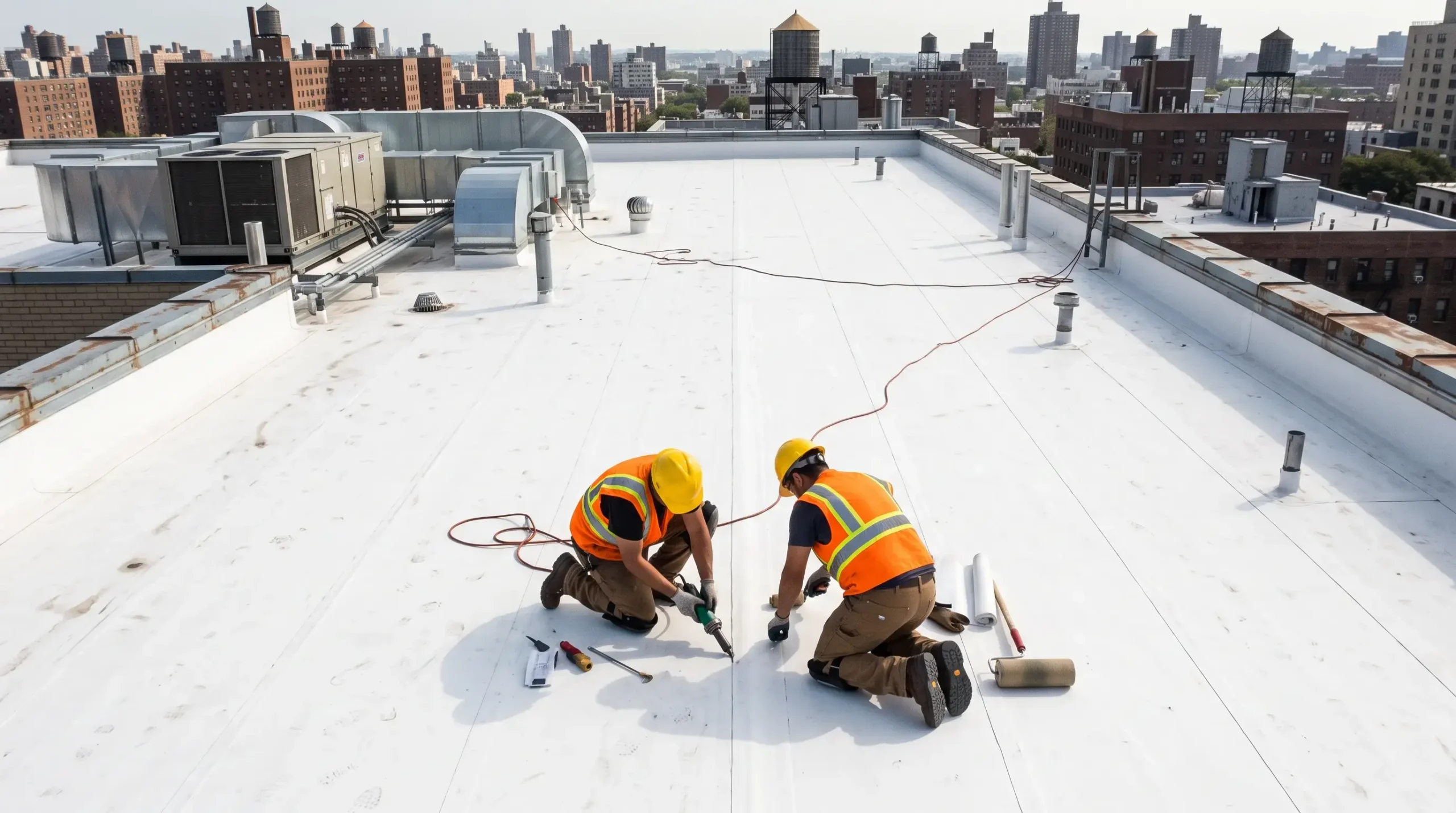
Flat roofs fail differently than pitched roofs. Water sits instead of running off, so seams and drains decide everything. Geovanny's Contracting Roofing installs, repairs, and maintains flat and low-slope roofs on homes in New York.

15+ Years on Roofs
01 Crew Start to Finish
12 NY Cities Served
Scroll
New York · Residential Flat Roofing in New York
4
Core Services
01 Overview · What's Included

A Flat Roof Is Never
Actually Flat

A flat roof is not actually flat. It carries a slight pitch toward drains or scuppers, and when that pitch goes away, water stays put. Ponding water is the most common reason a low-slope roof fails early, before the membrane wears out.

Most flat roofs on houses in this area are porch roofs, additions, and garage roofs rather than whole buildings. They get ignored because nobody sees them from the ground, and they leak into finished space below when they finally do give out.

  • Written scope before tear-off
  • Deck checked board by board
  • One crew, start to finish
02 What's Covered · 04 Sub-services

Everything
in the Roofing Scope

Each sub-service runs through the same inspection, the same written scope, and the same crew on the roof.

01 Flat Roof

Flat Roof Installation in New York

Flat roof installation in New York starts with the slope. A low-slope roof still needs pitch toward the drains, and that gets built into the deck or the insulation before the membrane goes down. Seams, edges, curbs, and drain flanges are the details that decide whether the new flat roof drains properly or ponds water somewhere in the middle instead. (60)

02 Flat Roof

Flat Roof Repairs in New York

Flat roof repair in New York covers open seams, blisters, punctures, cracked flashing at curbs and parapets, and drains that have pulled loose from the membrane. Ponding water is usually the reason the failure started. Most low-slope leaks trace back to a seam or a penetration, which is why finding the entry point matters more than patching the visible surface. (60)

03 Flat Roof

Flat Roof Maintenance in New York

Flat roof maintenance in New York clears the drains and scuppers before the next storm backs water up on the deck. Seams, laps, curb flashing, and pitch pockets are checked and resealed while they are still small jobs. Twice a year is realistic on a low-slope roof, since flat surfaces collect everything that lands on them and keep it there. (60)

04 Low-Slope Roofing

Low-Slope Roofing Solutions in New York

Low-slope roofing in New York covers porch roofs, additions, dormers, garages, and the flat sections that connect to a pitched roof. Those transitions are where shingles stop working and a membrane takes over. The tie-in between the two systems gets flashed as one assembly, because that joint is where most of these roofs start to leak in the first place. (60)

Our Work · 86 Projects

Our Work,
Up Close.

A sample of recent work from the field. Click any photo to view it full-size.

03 Field Checklist

Why Low-Slope Roofs Give
Out First

A pitched roof gets the benefit of gravity. A flat roof does not, so every weak point stays wet a lot longer.

01

Ponding Water

Water that sits on the roof for days works into every seam and breaks down whatever is holding them closed. (20)

02

Clogged Drains

Leaves and grit block the drain or scupper, and the roof turns into a shallow pool after one heavy storm. (20)

03

Failed Seams

Every lap between sheets is a joint, and joints move, shrink, and eventually open if nobody reseals them in time. (20)

04

Curb and Parapet Flashing

Anything rising off the roof needs flashing, and vents, skylights, and parapet walls are the usual leak points up there. (20)

05

Punctures From Traffic

Foot traffic from HVAC service or gutter cleaning punches through a membrane faster than most storms out here ever do. (20)

06

Wrong Slope

A low-slope roof built without enough pitch will hold water no matter how good the new membrane above it is. (20)

04 Our Process · 04 Steps

How Every Job
Actually Runs

Every job runs through the same ordered steps — no vague estimates, no surprises mid-job.

01
Step 01

Slope and Drain Check

Where the water sits today is mapped first, since that decides how the new roof gets built up. (18)

02
Step 02

Tear-Off and Deck

The old membrane comes off and the deck underneath is checked for soft spots and trapped moisture below. (18)

03
Step 03

Membrane and Flashing

The new system goes down with the seams welded or sealed and every penetration flashed as it comes. (18)

04
Step 04

Water Test and Cleanup

Drains are cleared and checked, the edges are finished, and the site is left clean before we leave. (18)

05 Why Choose Us

What You Get on
Every Job We Run

01

Slope Built In

Pitch toward the drains gets corrected during the install, not left as the same problem under new material again. (20)

02

Seams Are the Job

On a low-slope roof the seams are the roof, so they get the attention the open field never really needs. (20)

03

Drains Cleared Every Visit

Every maintenance visit ends with the drains and scuppers open, because a blocked drain undoes all the rest of it. (20)

Depends more on drainage and maintenance than on the material itself. A low-slope roof that drains properly and gets checked twice a year outlasts a better membrane that sits under standing water through every spring thaw and every heavy rain. (40)

Patching works when the membrane is otherwise sound and the leak is at one seam or penetration. If the field is brittle, blistered in several places, or holding water, patching just moves the leak somewhere else for a few months. (40)

Because they're two different systems meeting at a wall. The tie-in between a pitched roof and a low-slope section is the hardest detail on the house, and it's usually where these leaks start, year after year, on the same house. (40)

A little after a rain is normal. Water still sitting there two days later is not. That's when the seams start soaking, the membrane ages faster, and the deck underneath begins holding moisture it can't release on its own. (40)

Not by looking where the stain is. On a low-slope roof water travels sideways under the membrane before it drops through. We start at the seams, drains, and penetrations uphill from the stain instead of the spot directly above it. (40)

07 Service Area · 12 Cities

Cities We Serve
in New York

Roof installation, replacement, repair, and maintenance are scheduled in twelve cities in New York. The service area stays inside those cities and the towns immediately around them, which keeps travel time down and the schedule realistic.

08 Request Estimate

Ready to Fix a Flat Roof
in New York?

Send the details and get a free estimate covering the membrane, the drainage, and the flashing at every edge and curb.

Request Free Estimate

Response within 1 business day
Best Time to Call (optional)

We respond within 1 business day. No spam, no sales calls — just a scope and a price.